Facebook is all too keen to remind you of the past. Remember that concert you went to three years ago? That person you friended nine years ago? That photo you snapped on vacation last decade? No worries; Facebook will make sure you never forget.
But now more than ever, it's important to curate what pops up on your social media feeds, lest a potential employer or date stumble upon an ill-advised photo, comment, or like.
If you're sick of cringing every time you log into Facebook, it might be time to rid your account of aging memes and reminders of your 2008-era frosted tips phase. You don't have to nuke your entire account, though. Here's a more civilized solution for social media cleanup.
First, it may be informative to see what your profile looks like to people who aren't on your friends list. Go to your Facebook profile, open the three-dot menu next to the Edit Profile button (Add to Story on mobile), and click the View As "eye" icon. This will display your profile as it looks to the general public, by displaying everything on your profile that is set to Public.
Facebook makes it easy to delete your old posts with the Activity Log. Go to your profile, click the three-dot menu, and select Activity Log. This will show you every action you, or another user, has taken on your Timeline, including reactions, shares, comments, tags, and posts. The results can be filtered by date or a specific person.
On desktop, you can scroll through all your past actions on Facebook, or choose a category under the Activity Types header to view your posts, tags, or interactions. Click the Timeline, Photo and Tag Review drop-down to filter specific tags. Mobile users must select nested categories to view posts, tags, interactions, and more specific actions.
When you come across something you want to remove, select the three-dot menu to delete, hide, or archive; unlike a comment; or remove tag. If you wish to remove multiple posts at a time, tick the box next to the actions, then select Archive or Trash on the top right.
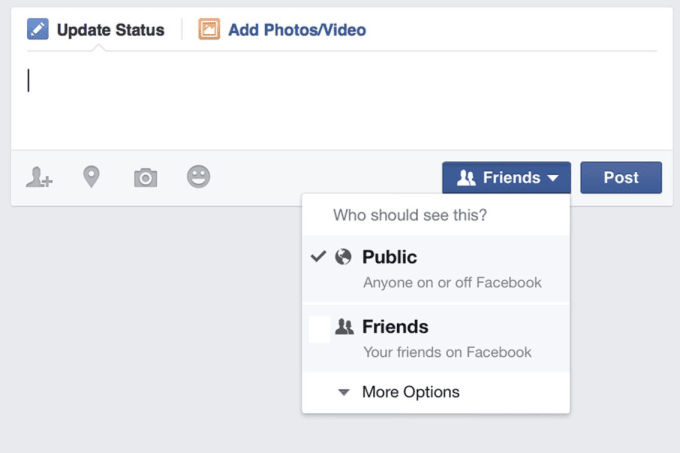
It's possible to limit the visibility of old photos and posts by making them private instead of deleting them entirely. From your Timeline, click the ellipsis next to the post you want to hide, select Edit Audience (Edit Privacy on mobile), then select who should have permission to view the post. Choose Only me to hide it from everyone else. To only hide the post from certain people, select Friends except... or Specific friends... to include or exclude certain friends.
Facebook also has a tool to hide public Timeline posts en masse. To do this, click the arrow in the top-right corner of your profile and navigate to Settings & Privacy > Settings > Privacy. Click the Limit Past Posts link to open a warning advising that all your public posts will be converted to Friends only. If that's okay, click the Limit Past Posts button and your public posts will only be visible to those on your friends list.
On mobile, tap the hamburger icon and select Settings & Privacy > Settings > Privacy Settings > Limit who can see past posts. Here, you can also edit how future posts will appear.
Don't want to lose your Facebook information forever? You can download a copy of your entire Facebook Timeline by navigating to Settings & Privacy > Settings > Your Facebook Information. Select the View link next to Download Your Information.
Choose what should and should not be included in the download, then click Create Files to download your Facebook information to your computer. Once a file is created, it can always be redownloaded from the Available Copies tab.
Sign up for Tips & Tricks newsletter for expert advice to get the most out of your technology.
This newsletter may contain advertising, deals, or affiliate links. Subscribing to a newsletter indicates your consent to our Terms of Use and Privacy Policy. You may unsubscribe from the newsletters at any time.
Thanks for signing up!
Your subscription has been confirmed. Keep an eye on your inbox!
Sign up for other newsletters
Skip to main content
The VergeThe Verge logo.The Verge homepage
The VergeThe Verge logo./
By Sheena Vasani / @SheenaV123
|
Samar Haddad / The Verge
Sure, Facebook can be a great way to connect and stay in touch with family and friends. Yet, more often than not, it’s a headache that can turn toxic thanks to the News Feed. Whether it’s fake news, envy-inducing vacation photos from a classmate you barely know, or a relative’s upsetting political post, there are just some things better left unseen. True, you could unfollow a page if you want to stop seeing those kinds of posts, but you can’t exactly unfollow your uncle or a close friend without potentially putting those relationships at risk.
Thankfully, there’s a way around it. It turns out, you can customize your Facebook feed so you don’t have to see their posts without needing to unfriend anybody. There are a number of ways to do so, whether you just want to hide a single post or hide all of someone’s posts indefinitely. We’ll guide you through your options here.
Click on the three dots near the top right of the post you’d like to get rid of.
A menu will pop up that you can use to hide, snooze, or unfollow posts.
And that’s it! As a side note, though, if you don’t wish to remove the profile’s posts entirely but simply see less of them, it might be a good idea to tap on Favorites. This will prioritize the posts of people and pages you want to see more of in your feed. You may still see the posts you don’t want to view, but it likely won’t be as often.
Don’t worry: if you ever wish to turn off a Snooze or follow somebody back, Facebook also offers a number of ways for you to do so. One of these is through customizing your feed.
Underneath your profile photo, click on “Settings & privacy.”
Under “Settings & privacy,” click on “Feed.”
You should now see a menu presenting you with a number of options.
After selecting “Feed,” you’ll see options that will allow you to undo a “Snooze,” follow profiles back, and more.
 It should turn black once you do so.
Click on the clock next to the profile to turn off the “Snooze.”
Click on the black filing box icon to follow the profile again.
And voila! You’re done. Now next time you come across a relative’s cringeworthy, most definitely politically incorrect Facebook post, you can just hit “Snooze.” When you’re ready, you can undo it whenever you please — and nobody will suspect a thing.
Most Popular
 UA
UA July 11, 2014, 15:00
2912
People on Facebook can be annoying - it's no secret. Scrolling through uninformative posts about politics and uninteresting updates in social games, we periodically remove one of our friends in order to improve our own news feed. But it can hurt the feelings of people who fall under such filtering, especially if in real life you communicate normally. Therefore, sometimes it’s not worth chopping off your shoulder, especially since Facebook has other ways to get rid of garbage in the feed. Mashable counted five such "workarounds".
If your feed periodically shows similar posts that you are not interested in (annoying statuses, progress reports in games or listened tracks), you can simply hide them from the feed. There is a special function for this. You can also mark a post as spam. At the same time, Facebook will ask what type of content you would like to see in your feed and offer to organize it personally for your interests.
If you select Make your feed better, Facebook will offer you a process to personalize your user experience. The social network will show what content you have little interest in and which friends you have not interacted with recently, and you can apply a restrictive filter to their publications. After that, messages that match this filter will be shown less frequently.
If your feed has too many friend statuses and updates, you can hide them. Select "Hide from Timeline" and then Facebook will ask you why you don't like this post. You can also block all posts of a specific user for one of the suggested reasons. For example, hide photos from your timeline that don't include you.
Facebook has built-in “Restricted” lists. If you add a user to this list, they will remain your friend, but their posts will not appear on your timeline. However, he will be able to see your posts. You can create your own lists and set up filtering options yourself.
If you're going to post something that might get some people into a bad reaction, you can limit your post's visibility and make it visible only to some people or a circle of friends. You can set the visibility of the post for a specific list of friends, or you can hide specific people by name to whom you would not like to show your publication.
There is a sixth way to get rid of "cats" without deleting friends - delete your own Facebook account. After that, nothing will distract you from work. From now on, you will have to go to Twitter only for the news.
Projector Creative&Tech Online Institute
Login / register
or
To remember me
By clicking "Login/Register" you agree to the terms "User Agreement" AIN. UA
UA
Forgot your password?
Password recovery
Please enter your e-mail. You will receive an email with a link to create a new password.
Back
The key to comfortable work with social services is a careful selection of contacts. But if Facebook has become the embodiment of information chaos for you, do not rush to delete friends or close your account altogether. Better try these not so drastic measures.
Let's say your feed is full of boring posts from school friends. But you don't want to unfriend them so you don't get caked in the face at a class reunion. How to be? Just unsubscribe from them without deleting them - your friends will not know about it. No matter how many such friends you have, Facebook will help you unfollow them all at once. If you have not yet discovered this opportunity for yourself, I will tell you briefly how to use it.
Done. Inappropriate entries will no longer appear in the feed. This way you can quickly unfollow any accounts whose posts have no place in your heart.
The more sources form the feed, the more difficult it is to digest the information coming from them. Therefore, Facebook allows you to break down the news feed into categories to make it easier to understand. Everything is simple. You group your favorite contacts by some common attribute (for example, "best friends", "my exes" or "colleagues"), creating separate lists for them. And then you view updates only for those accounts that interest you at a particular point in time. Here's how to organize it all.
In the future, you will be able to view news from sources from each list separately. The lists appear on the left side of the home page of the Facebook website and in the "More" menu in the mobile apps.
Facebook can hide posts that contain links to pages and entire sites that you don't want. Regardless of who shares these links. In the context of the political bacchanalia that rages on social networks, this function looks especially relevant. If you notice content from a hateful source in one of the news and want to avoid it in the future, do this with it.
You will no longer see news with links to a blocked resource. But the account that posted such a link will remain among your subscriptions. In the same elementary way, you can tell Facebook about other sources whose content you do not want to see in your feed.
There are many personal and corporate pages on Facebook, the owners of which publish good content, but do not know the measure and fill the subscribers' entire feed. On the one hand, I don’t want to unsubscribe from these sources, on the other hand, they often strain me. Most likely, there are such accounts in your contact list. Fortunately, Facebook allows you to reduce the amount of news from selected pages, which can be a solution. To cool down overzealous publishers, follow these steps.
As a result, entries from this and other accounts marked in this way will be less likely to get into your feed. In my experience, this seemingly obvious option is often overlooked. But in vain.
In addition, you have another way to reduce the amount of news from unwanted sources.
You can select the pages whose posts you want to see in the feed more often. Consequently, posts from the rest of the contacts on your list will flash before your eyes less often.

:no_upscale()/cdn.vox-cdn.com/uploads/chorus_asset/file/21871699/Screen_Shot_2020_09_11_at_10.32.05_AM.png)

