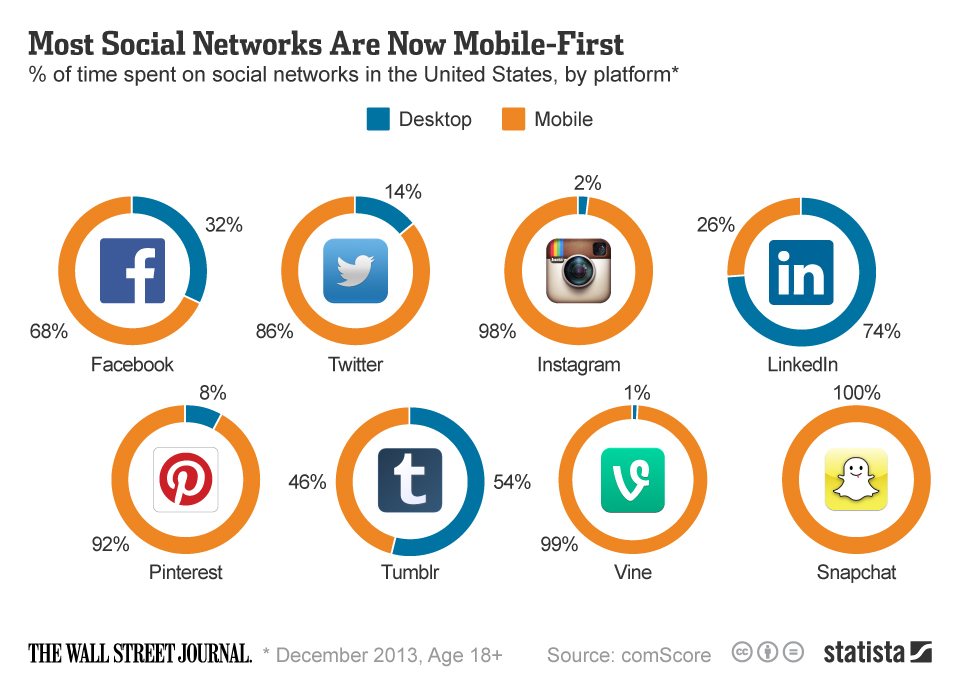
People have become more dependent on their smartphones to fulfill their browsing needs. Thus, websites have begun building two separate versions: a mobile version and a full-desktop version. Facebook is just one example. The mobile website comes in two flavors depending on the website’s code, including regular and light. The light mobile website versions generally present primary content. Still, they lack functionality better suited to a full-screen environment, such as menu navigation, link locations, options, and other page elements. Sites increasingly use responsive or adaptive web design, such as Facebook, to change and modify themselves to fit screens of any shape or size while still displaying content in a reasonable layout.
However, mobile sites like Facebook are often unsatisfactory in one way or another. More specifically, Facebook hides certain functionalities, limiting what mobile users can see or do while browsing the site. Though this strategy is applied to retain usability and run more smoothly on mobile platforms, it can often leave power users out in the cold when they’re looking for specific abilities or options on Facebook. After all, it can be frustrating when trying to visit a particular site for a specific feature (such as dark mode) and not getting the option when on the mobile version of the site.
Though the Facebook apps on iOS and Android theoretically feature the same capabilities as the desktop version, navigation is different, and many apps take you to the mobile version of the website instead of the app. It’s no secret that the Facebook app consumes a lot of battery life and memory on your phone, so the mobile site can be a much faster and more convenient way to access your social feed on the go.
Unfortunately, Facebook’s mobile browser site is more limited than the app in terms of capabilities. Facebook won’t let you use Messenger on the mobile browser. It will ask you to install the Messenger app instead. Changing your settings or hiding posts from your newsfeed can be aggravating.
If you’re fed up with the restrictions while using the Facebook mobile site or need to change a setting you can’t change from the mobile view, you’re in luck. Both Android and iOS allow you to easily switch between Facebook’s mobile and desktop versions with a single option.
Let’s break down just what you need to do to access the full desktop version of Facebook right from your iPhone or Android device.
As of May 01, 2022, major browsers like Chrome and most forks of Chromium like Edge and Opera support Facebook Desktop. However, Firefox, Safari, and other major, non-Chromium browsers tend not to work even if they offer a Desktop View option. When we tested Firefox, it continually went to the Facebook mobile website with “Desktop View” turned on, and the URL changed.
 The slider should move to the right and turn blue. You can always check it to ensure it is on.
If you haven’t logged into your Facebook account on your chosen mobile browser or got logged out, it will ask you to enter your login details. After logging in, you’ll still get the mobile web version or the Facebook app unless you changed the URL first. Don’t worry; you haven’t done anything wrong. Simply adjust the URL as needed by removing the m. portion in the URL. You must also ensure that the desktop option is on in the browser for this trick to work.
As tested on May 1, 2022, adding /home.php to the end of the URL no longer works when bookmarking the page for future use. You always have to turn the desktop option on and change the URL every time you want to load the Facebook Desktop version. There is no way around it like there used to be.
Also, as long as you browse Facebook on that specific tab, it will stay in desktop mode. Sometimes, though, you can go back to a page, and it will revert to the mobile version. When tested on Edge, the back button stayed in desktop mode for the most part since we clicked on various links.
***
While the above methods are helpful and easy enough to accomplish, it’s important to note that Facebook will try to reroute you back to using their mobile app under certain situations. If you reload the homepage or attempt to use specific settings, Facebook will push you back to the mobile site. If this happens, you can always use the above methods to reload the desktop version without too much issue.
Finally, while testing the above methods on Android, we ran into the occasional problem where requesting the desktop site through all browsers instead returned with a tablet version, with the same functionality as the mobile version but zoomed out. If this happens, the page is requesting a desktop version of “m.facebook.com,” which redirects to the mobile version of Facebook no matter the device you’re using. Just reenter “www.facebook.com” into your browser with the “Request desktop site” box still checked, and you should load the traditional display.
Home » Android » How to Open Facebook Desktop Site on Mobile Phone
By: Waseem Patwegar
While the mobile version of Facebook is optimized for mobile devices, it does not provide full functionality as available in its Desktop version. Hence, we are providing below the steps to Open Facebook Desktop Site on your Mobile Device.
By default, all mobile devices always open the mobile version of Facebook. This happens, both when you launch the Facebook App on your Mobile device and also if you try to open Facebook using the web browser installed on your Mobile Phone.
When you try to open Facebook by typing www. facebook.com in Google Chrome or Safari browser, Facebook will automatically detect that you are using a Mobile device (Phone or Tablet) and it will redirect you to the Mobile version of Facebook.
As mentioned above, the mobile version of Facebook is a stripped down version of Full Facebook Website that is only available on Laptop and Desktop Devices.
If you want to access the full functionality and features of Facebook, you can either visit Facebook on your computer or use workarounds as provided below to open Facebook Desktop Version on your Mobile Device.
Open Chrome browser > type Facebook.com in the search bar and hit the Go button. This will still take you to the mobile version of Facebook (m.facebook.com).
Once you land on the mobile version of Facebook, tap on 3-dots icon located at top-right corner and select Desktop Site option in the drop-down menu.
This will immediately take you to Facebook Login Page on the desktop version of Facebook (facebook. com).
com).
As you can notice, the desktop version of Facebook appears small and hard to read. To fix this, switch your Android Phone to Landscape mode and you will be able to get a better view of the website.
The Safari browser on iPhone and iPad provides the option to request the desktop version of any website.
Open Safari browser > type www.Facebook.com in the search bar and tap on the Go button. This will still take you to the mobile version of Facebook (m.facebook.com).
Once you land on Facebook mobile site, tap on the AA icon in Search bar and select Request Desktop Website option in the drop-down menu.
This will take you to the desktop version of Facebook, which will appear minimized and hard to read.
You can easily fix this issue by switching your iPhone to Landscape mode, which should provide a reasonably good view of the Desktop version of Facebook on your mobile device.
If you are already on Facebook (via Facebook App), you should be able to go to Desktop version of Facebook by typing the exact URL of Facebook Desktop Login page in Facebook search.
Open the Facebook App on your Mobile device and this will take you to the mobile version Facebook (m.facebook.com). Once you are on Facebook, tap on the Search icon located at top-right corner.
On the next screen, type https://www.facebook.com/login.php in the search bar and tap on the Go button.
This should take you to the Full Desktop Version of Facebook on your Mobile device (Phone or Tablet).
Facebook users are divided into two main categories: those who enter the social network infrequently (once or twice a day, or even less) and, in fact, live in the social network. The latter constantly check the feed, notifications, often post and even more often comment on the posts of other users. Such users probably want to spend less time logging into the system. Therefore, let's talk about how to display the Facebook login shortcut on the computer desktop or on the smartphone screen. nineOl000 using the main site. And there are ways to speed up the process of logging into the social network.
The simplest and most obvious option is install Facebook login shortcut on desktop. This is done like this:
And now a shortcut has appeared on the desktop that allows you to log into Facebook with almost one click.
There are several ways to display the Facebook icon on the screen of a mobile device.
Accidental deletion of the Facebook icon is not a tragedy. It can be returned if you hold your finger for a few seconds while clicking on the icon of the program for working in the social network.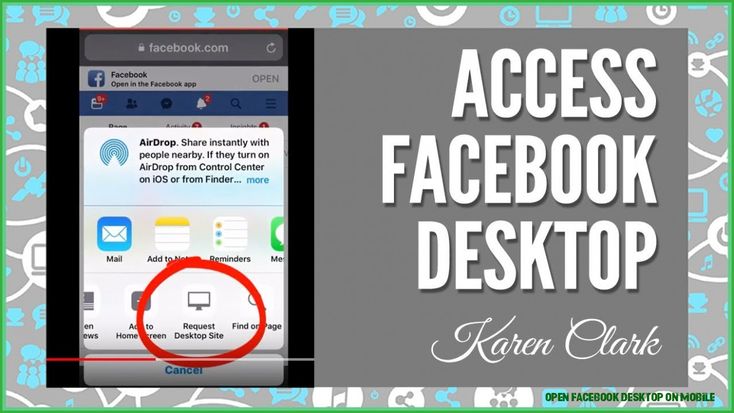 With this manipulation, the main screen opens, and the user has the opportunity to select a place on the desktop where he would like to place the icon.
When using a browser, you can bookmark a site or pin it to quick links. For example, in the FireFox browser, you need to click on the "ellipsis" to the right of the address bar and select "Pin bookmark". After that, the Facebook login icon will be displayed immediately when you enter the browser. nine0003
This procedure is even simpler in Google Chrome: click the "asterisk" in the address bar, and the social network is bookmarked. And if you often visit Facebook, then the link to the site will be displayed in quick links on the start page automatically.
You can make Facebook the browser start page, and then when you open it, you will immediately go to the social network.
 facebook.com/. nine0008
 Install the special Facebook client program for Windows. You can find it in the Microsoft app store, it's free. This client allows you to place shortcuts on the desktop and in the taskbar.
Important! Facebook client for Windows is only suitable for operating systems starting with Windows 10. Installation on 10 different computers is allowed from one account.
Client benefits:
If you're looking for ways to make communication easier, you might want to find the fastest way to log into your Facebook account. Of course, you can add Facebook to your browser, but this is not the best solution. nine0003
Did you know that there are many sites where you can find icons for your favorite applications? What's more, they offer various Facebook icons. All you have to do is choose the one you like the most. For example, if you don't like the icon that Facebook uses, you can choose an older version. In addition, you can choose more creative, artistic designs.
Don't worry, these sites are legal as long as you use the icon for personal purposes. nine0003
Windows programs, mobile applications, games - EVERYTHING is FREE, in our closed telegram channel - Subscribe :)
We used Icon Finder and show you how you can do it:
That's it! This is one of the best ways to customize your Facebook icon. nine0003
As you may have noticed, the website offers a lot of high quality icons for free. However, if you need more, you can purchase a membership and unlock even more options. The best thing about membership is that you can download premium icon packs and customize your desktop.
In addition, you can also download icons created by famous digital artists.
When you download the Facebook app on your Mac, its icon should automatically appear on your desktop. However, sometimes this does not happen, especially if there are already many applications on the desktop. nine0003
Don't worry, there's an easy way to add a Facebook icon. All you have to do is create a shortcut and it will bring the Facebook icon to your desktop. Here's how: